This bill, if approved as currently written, will be The Loss of the American People's Stake in Our Natural Biosphere

I wrote this letter;
To: United States Senate Committee on Energy and Natural Resources 11/11/26
Opposition to S.5653 - Bipartisan American Affordability and Jobs Act of 2026 "Permitting & Environmental Reviews"
- The Loss of the American People's Stake in Our Natural Biosphere.
This bill will rob the American people of their stake in the natural biosphere and its resources by eliminating public oversight of genetically engineered animals and plants, including organisms whose DNA can be designed or modified using technology exempted in the October 2026 NEPA CE list and the USDA's September 2025 AI Strategic Plan and the FDA IGAs... amongst countless other actions reguarding regulation of genetic engeering, by numerous agencies, all listed at the bottom of this email.
I am submitting these concerns to establish a formal public record of my objections to S. 5653 and its potential consequences for biotechnology oversight, the Endangered Species Act, and NEPA. I have spent years reviewing and responding to federal regulatory changes involving genetically engineered organisms, environmental protections, and public participation. I can show that these actions, when examined together, reveal a troubling pattern of diminishing transparency and accountability. I am asking Congress to acknowledge these concerns, preserve my statement in the official committee record, and investigate how these regulatory changes may affect the American people's right to know, participate in, and challenge decisions involving our natural biosphere with new technologies and engineered DNA by computers in the name of "restoration" and ultimately hidden from the public.
simple references supporting and verifying the accuracy of this statement:
- NEPA October 2026 CE List; Attached and available by googling it.
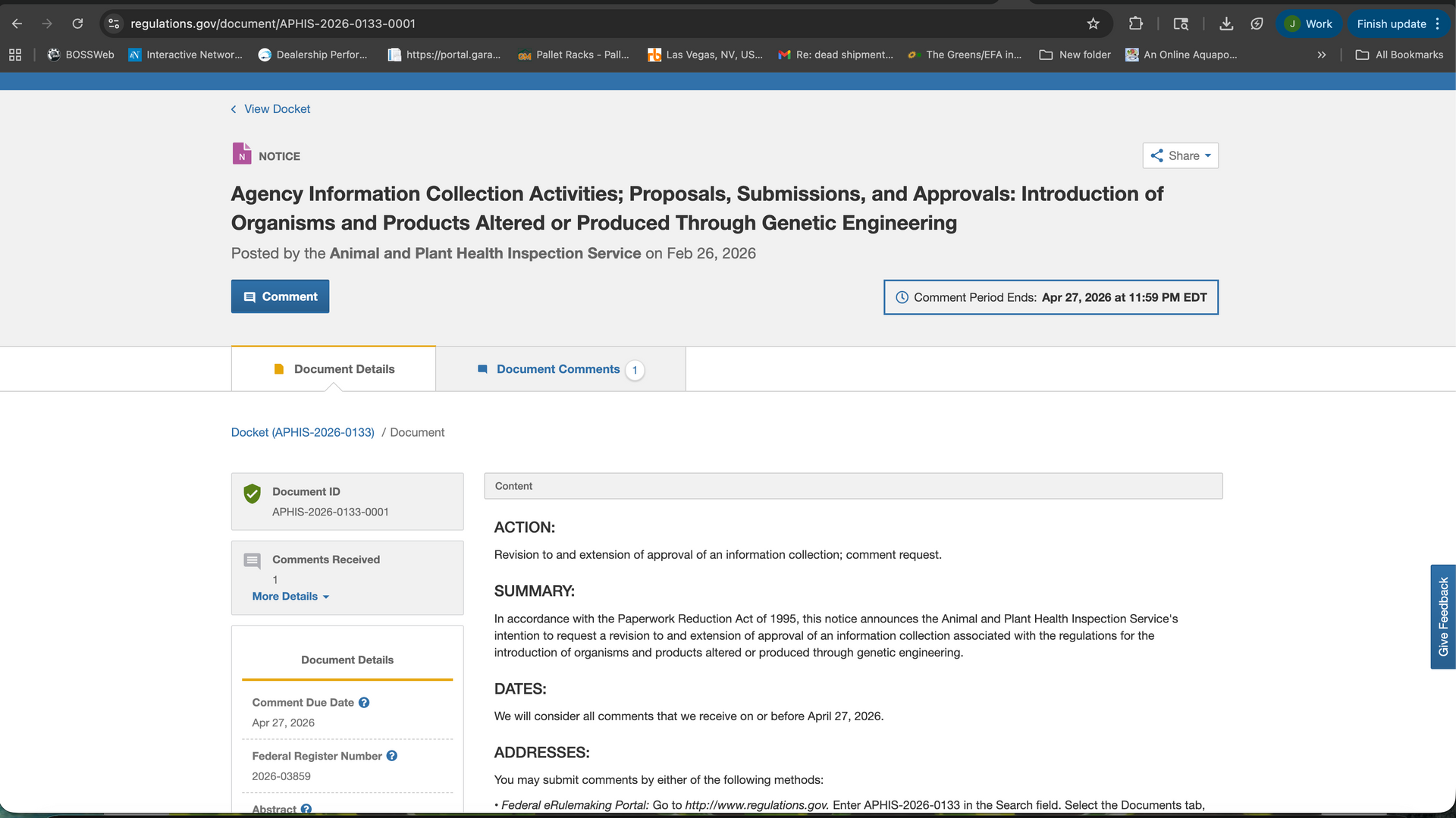
- 2 years of biotechnology regulation tree (attached and included at the bottom of this email) this tree easily explains the massive regulatory agenda to use biotechnology.
- USDA, Artificial Intelligence Strategy (September 2025). I request disclosure of how AI-assisted genetic engineering is being incorporated into federal biotechnology programs and environmental reviews. Attached
Provisions of S. 5653 That Stand Out to Me Upon quickly Reviewing the Bill
S. 5653, Section 1105 (page 28): Would allow agencies to rely on combinations of multiple categorical exclusions when determining the required level of NEPA review. (see the NEPA CE Exemption list attached)
S. 5653, Section 1108 (pages 62–63): Addresses the adoption and use of categorical exclusions across federal agencies. These provisions raise concerns about the expansion of activities proceeding without an environmental assessment or environmental impact statement.
S. 5653, Title III, Sections 1301–1305 (beginning page 133): Proposes amendments to the Endangered Species Act, including Section 7 consultation procedures and judicial review.
These changes are particularly troubling when considered alongside ESA recent changes in Sections 7 and 10, administered by the U.S. Fish and Wildlife Service, which govern consultations, incidental take permits, and habitat conservation plans and completely shield the identity of the permittees, and the "no surprise clause" will assure the developer that it was opperating in the name of known science at the time and no financial burden can come from it.
1401–1403 (project certainty) How can Congress justify making federal authorizations more difficult to revoke or modify when new scientific evidence reveals potential environmental harm? This is particularly concerning for activities affecting endangered species, where environmental consequences may not become apparent until years after an authorization is issued. Congress must explain how Section 1401 would affect ESA biological opinions, incidental take statements, and the ability of federal agencies to respond to newly discovered risks involving genetically engineered organisms.
and "eNEPA TECHNOLOGIES.—The term ‘eNEPA technologies’ means digital tools, applications, and other technological capabilities used by agencies to support the responsibilities of the agency with respect to environmental review or other types of authorizations." - What are the other capabilities?
A small list of other recent federal actions reinforces my concerns: ( dont forget to look at the bottom for a full list)
- FDA — March 2024: Guidance concerning Intentional Genomic Alterations (IGAs) in animals and the circumstances under which FDA may exercise enforcement discretion. See FDA Guidance for Industry #187A and #187B.
- USDA APHIS — 7 CFR § 1b.4(c)(10): NEPA categorical exclusions involving certain genetically engineered organisms, veterinary biologics, and related activities... Note that the APHIS is still in the process of new biotechnology regulations.
- USFWS — ESA Section 10(a)(1)(B), 16 U.S.C. § 1539: Incidental take permits and habitat conservation plans, including associated NEPA review procedures... and for the readers to find full insult from the USFWS please see the request they have in their June 1st "proposed rule, Organization, Functions, and Procedures; Public Notice and Comment for Standards, Criteria, and Guidance Applicable to Forest Service Programs" and my response. also, read into the new commitment with Texas-based Colossal Biosciences to map the ESAs DNA. and quote; “We can start to figure out what are the genes associated with things like disease mitigation or drought tolerance,” says James. “There are many different ways we can try to engineer nature to be more resilient in the future.” Whether merely enhanced or fully de-extincted, the listed animals fighting for their lives can be real-world beneficiaries of the public-private deal struck this week. “This is a service to America,” says Lamm. “It’s a global biological vision, [helping animals go] from freezer to free.”
- NEPA — 42 U.S.C. § 4336c: Statutory authority concerning categorical exclusions, which S. 5653 proposes to amend.
My central concern is that these federal actions, taken together, will systematically eliminate the public's ability to examine and challenge decisions involving genetically engineered organisms released into the natural environment and to oversee how the money, grants, and lease agreements that would be used for these extreme actions will be handled.
The public should be allowed to know who the scientists are responsible. Where are the environmental assessments, public records, and long-term monitoring requirements for these experiments? What protections remain when genetically engineered organisms affect endangered species or their offspring and bio-habitats? And who will be legally accountable if irreversible environmental harm occurs? - well what i am reading, its not good for the people.
Congress must examine the cumulative effect of these regulatory changes before advancing S. 5653. The American people must retain meaningful access to the records, scientific evidence, and an understanding of the experments that are being unleashed and what its doing to the environmental in the future. and is it to much to ask for judicial processes necessary to protect our stake in the natural biosphere?
By and For the people
Cheers, Josh Wilson
Learn more at byandforthepeople.org
11 - 11 - 2026 - submitted to fortherecord@energy.senate.gov .
For the official record, I respectfully request written confirmation that my submission has been received.
2-YEAR EVOLUTION OF RECKLESS BIOTECHNOLOGY REGULATION TREE.
The * to the spiciest stuff. With a quick overview description of hidden corruption and the dates to help you find the official documents.
Executive Branch
├── White House
│ ├── *Jan. 20, 2025 - Executive Order 14154 — Unleashing American Energy - (This E.O
rescinded a past E.O 11991- May 24, 1977 - No Environmental Impact Statements. Dangerous!)
│ └── *June 25, 2026 - Executive Order 14414 — Advancing Regenerative Agriculture and
Strengthening American Farm Resilience. ( This Executive Order does not say anything about
genetic engineering OR mention uses in Conservation and Restoration efforts... THAT'S THE PROBLEM. its the same Teck for the food system and the same devlopers)
│
├── Council on Environmental Quality (CEQ),They manage the rules of the NEPA
│ ├── May 1, 2024 - NEPA “Phase 2” Final Rule. Removes citicens voice to question science.
│ ├── May 2024 - Federal Agency Categorical Exclusion (CE) List ( Approved hidden Experiments )
│ ├──Apr. 15, 2026 - CEQ Permitting Technology Partnership & Interagency Cooperation
│└── *Oct 1, 2026 - A NEW LIST of Categorical Exclusions... (and it can always be added to)
├── USDA
│ ├── APHIS
│ │ ├── Nov. 13, 2024 - re establish SECURE Rule: Up to 12 GE Modifications Exempt
│ │ ├──*Feb. 26, 2026 – APHIS–2026–0133. Proposed extension of OMB Control No.
0579-0085 (Public recordkeeping for genetically engineered organisms. It's changing again)
│ │ ├── Apr. 3, 2026 – USDA NEPA Final Rule. (allows Release of biotech in public lands!)
│ │ └── May 15, 2026 - RFI — Future of Biotechnology Regulation (Part 340 / Part 330)
│ └── U.S. Forest Service
│ └── May 17, 2024 - FSM 2470 - Silvicultural Practices,Directives-4178(req to use biotech)
│└── *Jul 1, 2026 - Organization, Functions, and Procedures; Public Notice and Comment for Standards, Criteria, and Guidance Applicable to Forest Service Programs (no final rule yet; insulting proposed rule)
├── Department of the Interior (DOI)
│ ├── Bureau of Land Management (BLM)
│ │ └──*May 12, 2026 - Rescission of Conservation and Landscape Health Final Rule
│ └── U.S. Fish & Wildlife Service (USFWS) - (They Implement the Endangered Species Act)
│ ├──*Section 7 - November 21, 2025 – proposed revisions (Interagency Cooperation)
│ └── ESA Section 10 — Incidental Take Permits, Habitat Conservation Plans, and the "No Surprises Rule"-(1998)- no biotech experiments gone wrong will cost money to the inventor to fix.
│└── *Jun 25, 2026 - Department of the Interior Announces New Partnership to Advance Conservation of Imperiled Species Through Biobanking and Genomic Science. Partnership between the U.S. Fish and Wildlife Service and Colossal Biosciences will support innovative conservation tools for threatened and endangered species.
├── FDA
│ └── May 1, 2024 - Intentional Genomic Alterations (IGAs) in Animals (GFI 187A / Draft
GFI 187B) - Now, Biotechnology can be used for climate change adaptation in animal DNA!!!
├── EPA
│ └── Experimental Use Permit (EUP)- May 2020 - GE Insects, Biological Pesticides
│
└── Congress - Proposed NEPA Reform up and coming bills
├── Mar. 6, 2025 - H.R. 1897 — Endangered Species Act Amendments - Will allow
biotech to be used. / on the House floor to vote soon / A bipartisan bill.
├── Mar. 10, 2025 - H.R. 1994 — Public Land Renewable Energy Development Act %25 of energy to go to USFWS!
└── Dec 04, 2025 H. R. 4776 SPEED Act
└── S.5653 - Bipartisan American Affordability and Jobs Act of 2026